


 Português
Urgent Procurement Angola
- September 3, 2026
- 7 min read
- Logistics

PROCUREMENT INSIGHTS • ANGOLA
A practical guide for Angolan buyers, procurement managers and project teams working under real operational pressure.

Urgent industrial sourcing requires more than fast freight—it requires early alignment.
| THE CENTRAL PROBLEM
In many urgent purchases, the cost was created before procurement received the request: late visibility, incomplete specifications and an unrealistic required date. |
A pump seal is needed offshore. A shutdown team is waiting for a certified valve. A buyer receives a photograph and a short description, with delivery requested in Luanda within days. Procurement is then expected to solve the problem immediately—even when the requirement has been known by the requisitioning area for weeks.
This is common in project and maintenance environments. Operations focuses on keeping the asset running; engineering focuses on technical compliance; procurement enters late and is measured mainly on delivery. When these teams are not aligned early, the buyer loses the time needed to clarify the specification, identify alternatives, compare local and imported options, consolidate cargo and select the right Incoterm.
The result may be air freight, repeated customs costs, idle personnel—or an item that arrives quickly but is technically wrong.
A requisition may reach procurement only after the work order, shutdown or mobilisation date is fixed. The requested date then reflects when the item is wanted—not what the supply market can realistically deliver.
Early alignment between the requisitioner, engineering, operations and procurement is therefore essential. Together they should confirm the real operational consequence, specification, required-on-site date, approved brands and acceptable alternatives before the RFQ is issued.
Luanda has active industrial suppliers, but many OEM-specific, ATEX-certified, high-pressure, subsea and instrumentation items are not routinely stocked. Demand is specialised and holding slow-moving inventory is expensive.
The sourcing route may therefore start in South Africa, Europe, the Middle East, Asia or the Americas. When the request is late, the buyer cannot wait for manufacture, sea freight or normal consolidation. Availability—not price—starts driving the award.

Cost control begins when operations, engineering, the requisitioner and procurement work from the same plan.
Requests often arrive with an old photo, partial description or unverified part number. Missing voltage, material, pressure class, dimensions or certification creates clarification delays and wrong-item risk.
| PRACTICAL RULE
An urgent RFQ should still contain the exact manufacturer or approved alternative, part number, specification, quantity, certificates, photographs, delivery point and required-on-site date. |
A local supplier may quote stock in Luanda with local delivery. An overseas supplier may quote Ex Works or FCA, leaving collection, export packing, freight, insurance, customs clearance and final delivery to the buyer. Comparing only the unit prices gives the project an incomplete picture.
Each quotation should state the Incoterm and named place. The comparison must bring both options to the same endpoint—ideally the project’s required delivery location in Angola—and include lead time, technical compliance, taxes and duties where applicable, logistics cost and delivery risk.
International orders require aligned invoices, packing lists, product descriptions, origin and conformity documents, freight bookings, customs brokerage and local delivery. Any inconsistency can hold cargo while the operational deadline continues.
Urgent air freight does not guarantee urgent delivery. The documents should be reviewed before collection, the customs route agreed before dispatch and the receiving team ready before the cargo arrives.
For imported materials, documentation and clearance planning are part of procurement—not activities to start after arrival.
A low-value component may still attract collection, export, minimum freight, brokerage and local delivery charges. Separate departmental orders repeat those fixed costs; consolidation requires visibility across projects and functions.
A higher local price may be justified when verified stock protects a shutdown or prevents offshore downtime. An imported option may be better for a planned requirement or larger quantity. The correct decision is not automatically “buy local” or “import”; it is the option with the best balance of total delivered cost, technical compliance, lead time and project risk.
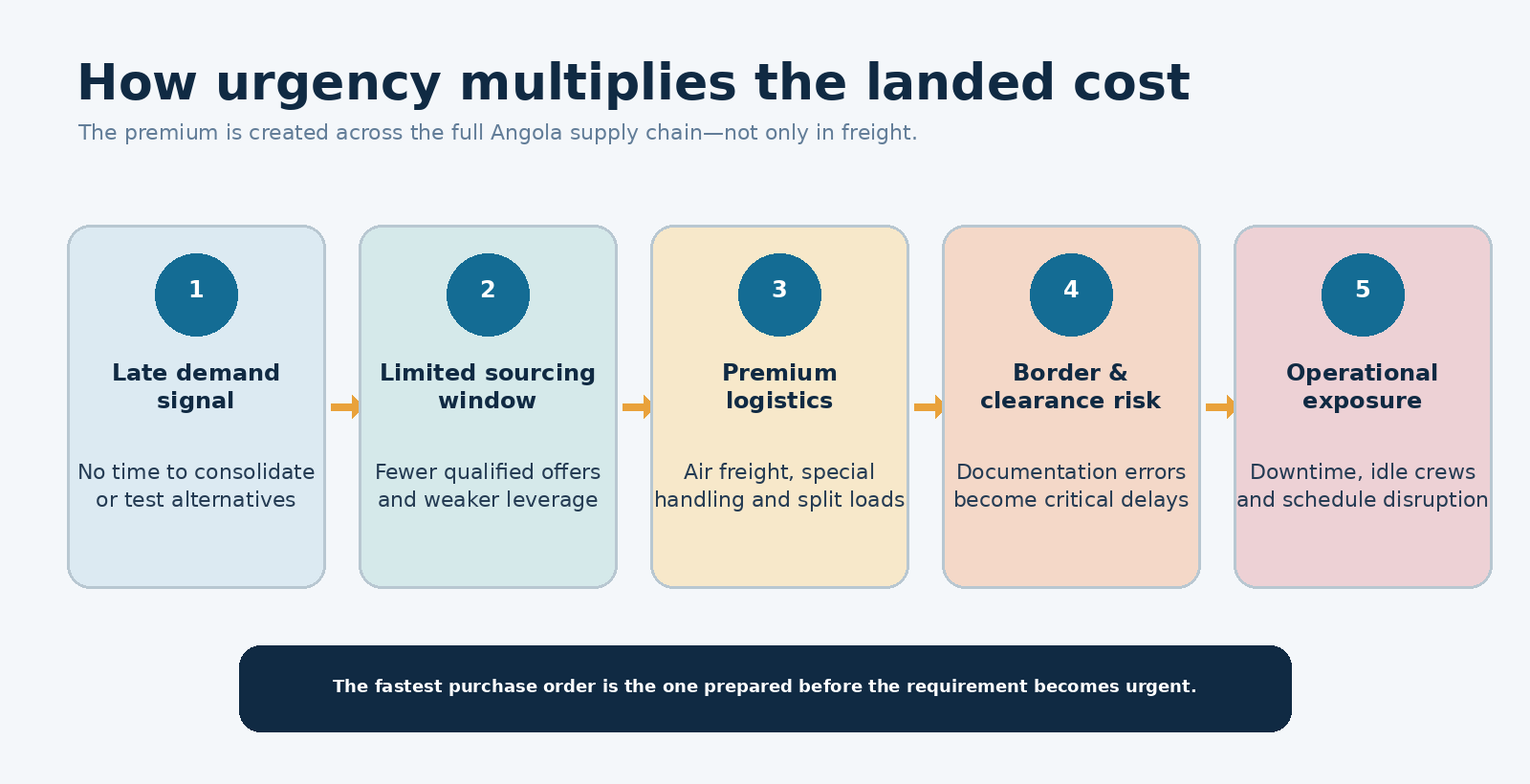
Urgency multiplies cost across the complete supply chain—not only in freight.
Operations, engineering and procurement should answer six questions together:
Urgent requirements will remain part of Angola’s oil, gas and industrial market. Equipment fails, offshore priorities change and projects face genuine schedule pressure. The objective is not to eliminate every urgent order; it is to prevent avoidable urgency and respond better when urgency is real.
That requires shared planning, technically complete requisitions, realistic delivery dates, clear Incoterms, qualified supply routes and active control of every handover. Procurement creates the greatest value when it is involved before the request becomes an emergency.
| KOZATTI PERSPECTIVE
The right sourcing decision connects technical compliance, international supply, Angolan import realities and the project’s operational priority—so the item is not only purchased, but delivered where and when it is actually needed. |
KOZATTI supports organisations in Angola with procurement coordination, international sourcing and supply-chain execution for project and operational requirements. Speak with our team about your next RFQ, planned material package or urgent sourcing challenge.
Talk to KOZATTI about your procurement requirement →
For the KOZATTI website team—not part of the public article.
| Primary keyword | urgent procurement in Angola |
| SEO title | Why Urgent Procurement Is Expensive in Angola | KOZATTI |
| Meta description | Why urgent oil and gas procurement costs more in Angola—and how buyers, engineers and project teams can reduce freight, clearance and delivery risk. |
| Suggested URL | /insights/urgent-procurement-cost-angola |
| Audience | Angolan buyers, procurement managers, project managers, engineers and operational requisitioners |
| Internal links | Procurement Services; Temporary Manpower Solutions; Minor Maintenance Services; Contact |
| Recommended CTA | Talk to KOZATTI about your procurement requirement |